Lake Mead Water Level Today - 1,037.19 ft, 26.0% Full
Hoover Dam · Colorado River · Nevada / Arizona - updated daily from official gauges
Western Reservoir Conditions·Daily·No. 91··Latest reading
- Lake Mead is 26.0% full - very low on this site's capacity scale - as of . Surface elevation 1,037.19 feet, storage 6,785,520 acre-feet (capacity basis 26,120,000 acre-feet), per U.S. Bureau of Reclamation gauge data.
- That elevation is 0.01 feet above its record low of 1,037.18 ft (, the lowest since the reservoir first filled), in a daily record going back to February 2, 1935 (Reclamation's period of record for this daily series).
- Storage is 38% of the October 21 average across 92 years of record.
- Lake Mead is falling: elevation changed -0.35 ft over the past week, -1.00 ft over the past month, and -20.49 ft over the past year, per U.S. Bureau of Reclamation gauge data.
Lake Mead is within 0.01 feet of the lowest surface elevation in its daily record, set on .
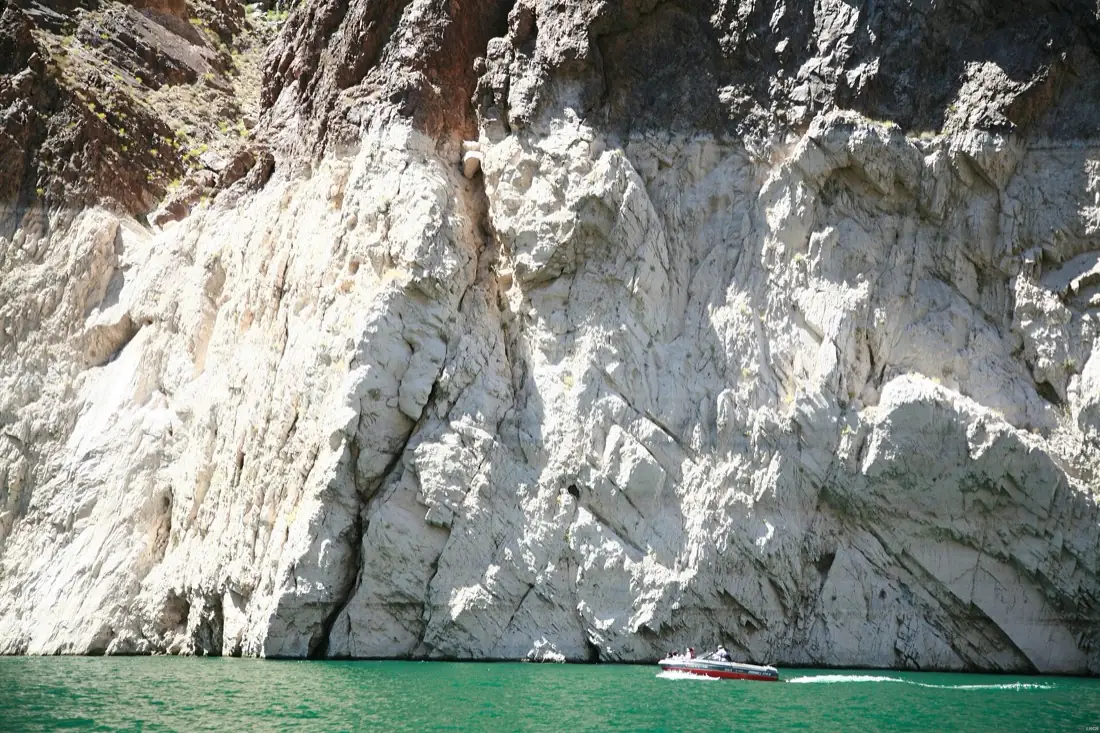
Lake Mead - distance to operating thresholds
- Shortage Tier 1 - 1,075 ft37.8 ft below
- Shortage Tier 2 - 1,050 ft12.8 ft below
- Shortage Tier 3 - 1,025 ft12.2 ft above
- Dead pool - 895 ft142.2 ft above
Distances are the live surface elevation minus each published operating level. Context: shortage tiers · dead pool.
Boat ramps: published launch elevations vs today's level. See ramp status →
Lake Mead vs its record low
In the daily record used by this site (going back to February 2, 1935 (Reclamation's period of record for this daily series)), Lake Mead's lowest surface elevation since it first filled (first near-full reading 1941) was 1,037.18 feet on , when storage was 6,784,840 acre-feet - the widely reported July 2022 low. As of , Lake Mead is at 1,037.19 feet - 0.01 feet above that record. The record high in the same series was 1,225.83 ft on .
Lower Basin shortage determinations are made from the projected January 1 elevation, not the daily reading. For CY 2026 a Level 1 Shortage Condition (2007 Interim Guidelines Section 2.D.1.a) plus DCP contributions govern Lake Mead operations - see Colorado River shortage tiers for the 1,075 / 1,050 / 1,025 ft thresholds and where the lake stands against each.
Reclamation's September 2026 Most Probable 24-Month Study projects Lake Mead at 1,034.18 feet on December 31, 2026 - below the July 2022 record low. Published projections, with the Probable Minimum scenario and source PDFs: USBR 24-Month Study projections. More Lake Mead context: the record-low tracker · Mead vs Powell · dead pool · minimum power pool · the bathtub ring · boat ramp elevations.
Lake Mead storage in context
| Reading | Elevation (ft) | Storage (AF) | % full |
|---|---|---|---|
| Today (October 21, 2026) | 1,037.19 | 6,785,520 | 26.0% |
| One year ago | 1,057.68 | 8,248,140 | 31.6% |
| Five years ago | 1,067.63 | 9,012,230 | 34.5% |
| Record low (October 19, 2026) | 1,037.18 | 6,784,840 | 26.0% |
| Capacity basis | 1,219.60 | 26,120,000 | 100.0% |
Lake Mead water level, past 12 months
26.0% full at the latest reading - across the past 12 months it ranged from 26.0% (October 19, 2026) to 34.1% (March 2, 2026). Percent full is storage against the 26,120,000-acre-foot capacity basis, not a share of the elevation plotted above.
Lake Mead elevation, full record
26.0% full at the latest reading - across the storage record since May 28, 1937 it ranged from 26.0% (October 19, 2026) to 114.5% (July 8, 1942). Percent full is storage against the 26,120,000-acre-foot capacity basis, not a share of the elevation plotted above. Every percentage here is measured against today's capacity basis; a reservoir's surveyed capacity changes as sediment accumulates behind the dam, so early-record percentages are indicative rather than exact.
Last 14 daily readings
| Date | Elevation (ft) | Day change | Storage (AF) |
|---|---|---|---|
| October 21, 2026 | 1,037.19 | +0.01 ft | 6,785,520 |
| October 20, 2026 | 1,037.18 | +0.00 ft | 6,784,840 |
| October 19, 2026 | 1,037.18 | -0.06 ft | 6,784,840 |
| October 18, 2026 | 1,037.24 | -0.07 ft | 6,788,920 |
| October 17, 2026 | 1,037.31 | -0.12 ft | 6,793,670 |
| October 16, 2026 | 1,037.43 | -0.10 ft | 6,801,830 |
| October 15, 2026 | 1,037.53 | -0.01 ft | 6,808,630 |
| October 14, 2026 | 1,037.54 | -0.08 ft | 6,809,310 |
| October 13, 2026 | 1,037.62 | -0.03 ft | 6,814,760 |
| October 12, 2026 | 1,037.65 | -0.06 ft | 6,816,800 |
| October 11, 2026 | 1,037.71 | +0.06 ft | 6,820,890 |
| October 10, 2026 | 1,037.65 | +0.05 ft | 6,816,800 |
| October 9, 2026 | 1,037.60 | -0.01 ft | 6,813,390 |
| October 8, 2026 | 1,037.61 | - | 6,814,080 |
Frequently asked questions
What is the water level of Lake Mead today?
As of October 21, 2026, Lake Mead's surface elevation is 1,037.19 feet, with 6,785,520 acre-feet in storage - 26.0% of the 26,120,000 acre-foot capacity basis. Source: Bureau of Reclamation daily gauge data.
How full is Lake Mead?
Lake Mead is 26.0% full as of October 21, 2026. Its storage is 38% of the October 21 average across its record since 1935. Source: Bureau of Reclamation daily gauge data.
When was Lake Mead last full?
Lake Mead was last at or above 95% of its 26,120,000 acre-foot capacity basis on March 16, 2000. As of October 21, 2026 it is 26.0% full. Source: Bureau of Reclamation daily gauge data.
Is Lake Mead rising or falling?
Lake Mead is falling: its elevation changed -0.35 feet over the week ending October 21, 2026, -1.00 ft over the past month, and -20.49 feet over the past year. Source: Bureau of Reclamation daily gauge data.
What was Lake Mead's lowest water level on record?
Lake Mead's lowest surface elevation since it first filled (its first near-full reading in this series is from 1941) was 1,037.18 feet on October 19, 2026, per the daily record used by this site. As of October 21, 2026 the reservoir is 0.01 feet above that record low.
How close is Lake Mead to dead pool?
Dead pool at Lake Mead is elevation 895 feet - below that, water cannot pass through Hoover Dam by gravity. As of October 21, 2026, at 1,037.19 feet, Lake Mead is 142.2 feet above dead pool. Source: Bureau of Reclamation daily gauge data.
About this gauge
Lake Mead, formed by Hoover Dam on the Colorado River at the Nevada–Arizona border, is the largest reservoir in the United States by capacity. It supplies water to Nevada, Arizona, California, and Mexico.
- Operator
- Bureau of Reclamation (RISE)
- Station
- Daily series item 6123 (elevation), 6124 (storage)
- Measurements
- Hoover Dam - Reclamation daily reservoir record
- Dam
- Hoover Dam
- River
- Colorado River
- State
- Nevada / Arizona
- Coordinates
- 36.0163, -114.7374 (USBR RISE location 3514)
- Full pool reference
- 1,219.6 ft
- Capacity basis
- 26,120,000 acre-feet (USBR Lower Colorado River Daily Report)
- Period of record
- February 2, 1935 (Reclamation's period of record for this daily series)
- Status
- Provisional - subject to revision by the reporting agency
- Update cadence
- Daily
Download the daily CSV (date, elevation ft, storage AF) or see all data downloads.
Other reservoirs tracked
Colorado River system: Lake Powell, Lake Mohave, Lake Havasu, Flaming Gorge Reservoir, Blue Mesa Reservoir, Navajo Reservoir.
Also: Shasta Lake, Lake Oroville, Folsom Lake, Lake Berryessa, New Melones Lake, Trinity Lake, Don Pedro Reservoir, San Luis Reservoir, Lake Travis, Lake Buchanan, Canyon Lake, Amistad Reservoir, Falcon Lake, Elephant Butte Reservoir, Lake Abilene, Lake Alan Henry, Lake Amon G Carter, Aquilla Lake, Lake Arlington, Lake Arrowhead, Lake Athens, Lake Austin, B. A. Steinhagen Lake, Bardwell Lake, Belton Lake, Benbrook Lake, Lake Bob Sandlin, Bois d'Arc Lake, Lake Bonham, Brady Creek Reservoir, Bridgeport Reservoir, Lake Brownwood, Caddo Lake, Cedar Creek Reservoir, Champion Creek Reservoir, Lake Cherokee, Choke Canyon Reservoir, Lake Cisco, Lake Coleman, Coleto Creek Reservoir, Lake Colorado City, Comanche Creek Reservoir, Lake Conroe, Lake Corpus Christi, Lake Crook, Lake Cypress Springs, E. V. Spence Reservoir, Eagle Mountain Reservoir, Lake Fork Reservoir, Fort Phantom Hill Reservoir, Lake Georgetown, Gibbons Creek Reservoir, Lake Graham, Lake Granbury, Granger Lake, Grapevine Lake, Greenbelt Lake, Halbert Lake, Hords Creek Lake, Lake Houston, Houston County Lake, Hubbard Creek Reservoir, Moss Lake, Inks Lake, Lake J.B. Thomas, Lake Jacksonville, Cooper (Chapman) Lake, Joe Pool Lake, Lake Kemp, Lake Kickapoo, Lake O the Pines, Lavon Lake, Leon Reservoir, Lewisville Lake, Lake Limestone, Livingston Reservoir, Lost Creek Reservoir, Lake L. B. Johnson, Mackenzie Reservoir, Lake Marble Falls, Martin Lake, Medina Lake, Lake Meredith, Millers Creek Reservoir, Lake Mineral Wells, Monticello Reservoir, Mountain Creek Lake, Murvaul Lake, Lake Nacogdoches, Lake Nasworthy, Navarro Mills Lake, New Terrell City Lake, Lake Nocona (Farmer's Creek), North Fork Buffalo Creek Reservoir, O. C. Fisher Lake, O. H. Ivie Reservoir, Oak Creek Reservoir, Lake Palestine, Palo Duro Reservoir, Lake Palo Pinto, Lake Pat Cleburne, Pat Mayse Lake, Possum Kingdom Lake, Proctor Lake, Lake Ray Hubbard, Ray Roberts Lake, Red Bluff Reservoir, Richland-Chambers Reservoir, Sam Rayburn Reservoir, Somerville Lake, Lake Stamford, Stillhouse Hollow Lake, Lake Striker, Lake Sulphur Springs, Lake Sweetwater, Lake Tawakoni, Lake Texana, Lake Texoma, Toledo Bend Reservoir, Twin Buttes Reservoir, Lake Tyler, Waco Lake, Lake Waxahachie, Lake Weatherford, White River Reservoir, Whitney Lake, Lake Worth, Wright Patman Lake.
Notes
- 1/Percent full is storage divided by the 26,120,000 acre-foot capacity basis published in the USBR Lower Colorado River Daily Report. ↩
- 2/Elevations are from Bureau of Reclamation RISE daily series item 6123 (storage item 6124) for Hoover Dam. Reclamation publishes these as provisional and may revise them. ↩
- 3/Gauge coordinates 36.0163, -114.7374 - USBR RISE location 3514. Elevations are as published by the operating agency; consult the source for the vertical datum in use. ↩
- 4/Period of record for the daily series used here begins February 2, 1935 (Reclamation's period of record for this daily series). Record low is measured over that window only. ↩
- 5/All readings carry the date the gauge reported them, which may lag today's date. This site publishes observations, not forecasts. ↩